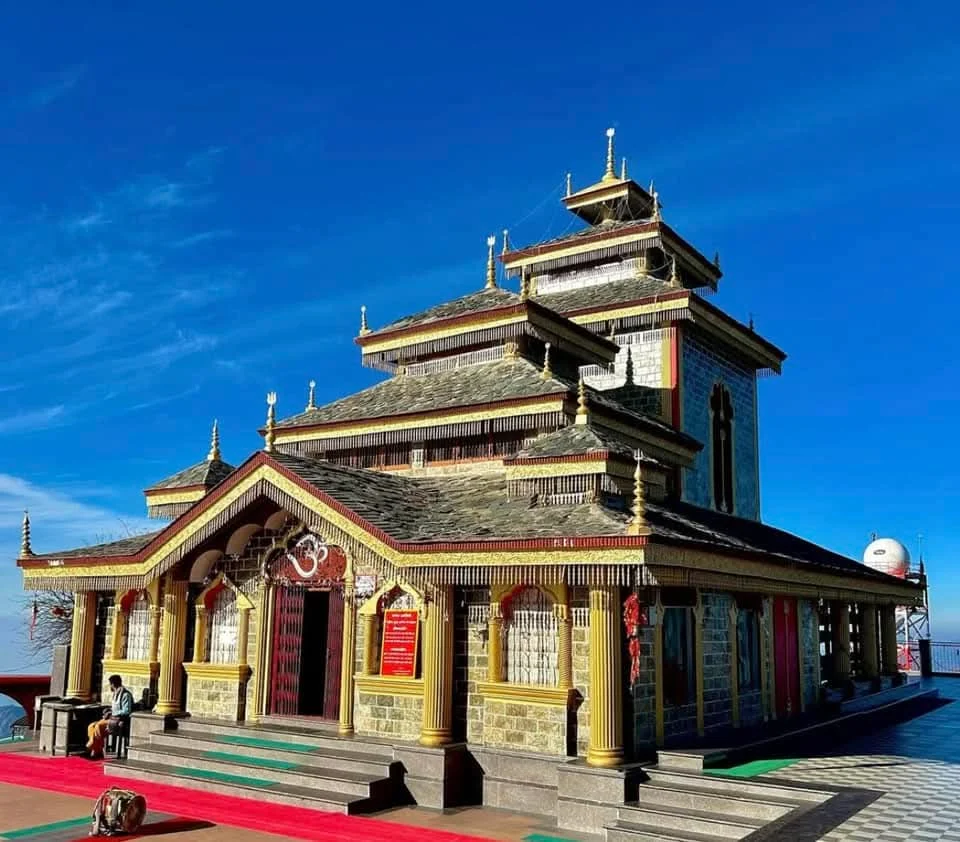
Surkanda Devi Temple is one of the 51 sacred Shakti Peethas of India, perched at an altitude of 2,756 metres (9,042 feet) in the Tehri Garhwal district of Uttarakhand. It is dedicated to Goddess Sati — the consort of Lord Shiva — and marks the legendary spot where her head fell to earth, making this one of the most spiritually significant temples in the Himalayas. The temple is located near Kaddukhal village, approximately 8 km from Dhanaulti and 24 km from Chamba. Temple timings are 5:00 AM to 7:00 PM (summer) and 7:00 AM to 5:00 PM (winter). The best time to visit is March to June and September to November. A ropeway (₹177 round trip) and a 1.5–2 km trek from Kaddukhal both lead to the summit.
Why is it Called "Surkanda"? The Mystery Hidden in the Name
Before the story, there is the name — and the name itself is a clue, a whisper from ancient Sanskrit that tells you exactly what happened here thousands of years ago.
"Surkanda" is derived from two Sanskrit words: Sir, meaning "head," and Khanda, meaning "fragment" or "fallen piece." Together: the fragment of a head. The temple was originally known as Sirkhanda or Sirkanda — a name that over centuries evolved into the Surkanda we know today. Every time someone says the temple's name, they are unknowingly reciting the ancient record of what happened at this ridge — the moment a goddess's head touched this earth and made it sacred forever.
That is the kind of place Surkanda Devi is. A place where the name itself is a story.
The Cosmic Legend: Love, Sacrifice & a God's Grief
To understand Surkanda Devi, you need to go back to a story that the Puranas call one of the most world-shaking events in Hindu cosmology — a story about a daughter, a father's pride, a husband's grief, and a divine act that literally shattered a goddess's body across the Indian subcontinent.
It begins with Sati. She was the daughter of Daksha Prajapati — a powerful king of the gods — and the consort of Lord Shiva, the great ascetic. But Daksha despised Shiva. He saw his son-in-law as an outsider: wild, matted-haired, smeared in ash, dwelling in cremation grounds, surrounded by ghosts and wanderers. In Daksha's court of gleaming gods, Shiva was an embarrassment.
When Daksha organised a grand Yajna — a sacred fire ceremony to which all the gods of heaven were invited — he excluded Shiva deliberately. And though Shiva urged her not to go, Sati could not bear the insult of not being invited to her own father's house. She went alone.
What happened next was devastating. At the Yajna, Daksha publicly ridiculed Shiva before all the assembled gods. He called him unworthy, uncivilised, unfit. Sati stood in that hall and listened to her husband being shamed. And she could not survive it. In an act of defiance and grief so absolute it ended her mortal form, Sati stepped into the Yajna fire and immolated herself.
When Shiva learned what had happened, the universe trembled. The god of destruction was now consumed by a grief that threatened to become destruction itself. He descended to the Yajna, demolished it, and lifted Sati's charred body onto his shoulder. Then he began to wander — through forests, across mountains, over oceans — carrying her, unable to let go, performing his cosmic Tandava dance of grief and rage that shook the planets in their orbits.
The other gods watched in terror. A grieving Shiva performing Tandava was not a metaphor. It was the end of everything.
Lord Vishnu intervened. Following Shiva across the cosmos, he used his divine weapon — the Sudarshana Chakra, a spinning discus of pure light — to gently, precisely, dismember Sati's body as Shiva carried it. Her body fell apart into 51 pieces. Each piece fell to a different place across the Indian subcontinent. Wherever a part of Sati landed, the earth became sacred. These places became the 51 Shakti Peethas — the most powerful goddess temples in all of Hinduism.
At this ridge in Tehri Garhwal, on this particular slope above the valleys, Sati's head fell to earth. The site was named Sirkhanda — the fallen head. And here, at the place of divine consciousness descending from the heavens, the temple of Surkanda Devi was born.
In Hindu metaphysics, the head is considered the seat of Chaitanya — pure consciousness and awareness. Of all 51 Shakti Peethas, this site therefore carries a unique spiritual weight: it is where divine consciousness itself touched the earth.
The Second Legend: How Indra Reclaimed Heaven Right Here
There is a second story connected to Surkanda Devi that is less widely known but equally extraordinary — and it is recorded in the Skanda Purana and Kedarkhand, two of the ancient Hindu scriptural texts.
Long ago, the Asuras — demons of great power — defeated Indra, the king of heaven, and seized his throne. Indra, stripped of his kingdom and his power, wandered the earth as a fugitive god, humbled and lost. In his desperation, he made his way to this ridge in Tehri Garhwal — to the sacred Shakti Peeth of Surkanda.
Here, Indra performed intense penance before Maa Sureshwari — the form of the goddess worshipped at Surkanda, whose name means "the goddess who rules over the gods themselves." He prayed for days without rest. And the goddess answered.
Blessed by Surkanda Devi, Indra returned to heaven and reclaimed his kingdom from the Asuras. The king of gods owed his throne to the goddess of this mountain ridge in Uttarakhand.
This is why, to this day, devotees believe that those who come to Surkanda Devi with a true heart never leave empty-handed. The ancient promise is preserved in the name of the goddess herself: Sureshwari — she who grants even what kings cannot achieve alone.
Stay close to Surkanda Devi — in Chamba, just 24 km away
Atithi Kutir is a family-run guest house and restaurant in Chamba, New Tehri — the most comfortable base for a Surkanda Devi visit. Return from the trek to warm Garhwali food, clean rooms, and a valley view. We can suggest local taxi contacts for the drive to Kaddukhal too.
Historical Roots: From Katyuri Kings to a Modern Pilgrimage
The mythology is ancient and undated. The documented history of the temple, as best as scholars can reconstruct it, traces back to the reign of the Katyuri dynasty in the 8th century AD. The Katyuris were a powerful Garhwali royal family who patronised many of the sacred temple sites across Uttarakhand — and oral traditions, preserved by the Lekhwar Brahmin priests of Pujaldi village who have served this temple for generations, suggest that Surkanda Devi was among the sites they honoured and developed.
Through the centuries that followed — through the rise and fall of the Garhwal kingdoms, through the Gurkha invasions of the early 19th century, through British administration and the modern state of Uttarakhand — the temple persisted. Its priests never left. The Lekhwar Brahmins of Pujaldi village have maintained this hereditary responsibility for centuries: conducting the daily aarti, performing puja, maintaining the sanctum. The same families, the same rituals, generation after generation, in a line of devotion that connects this hilltop to ancient India.
A significant modern milestone came in 2022, with the inauguration of the Surkanda Devi Temple ropeway — a 502-metre cable car that now allows elderly devotees, families with young children, and those with mobility limitations to reach the hilltop without the full trek. The ropeway has made Surkanda Devi accessible to a far wider circle of pilgrims while preserving the trek for those who choose to make it their spiritual journey.
Today, Surkanda Devi forms one point of a celebrated pilgrim circuit in Tehri Garhwal known as the "Devi Darshan Triangle" — three goddess temples: Surkanda Devi, Kunjapuri, and Chandrabadni — each on a different ridge, each an ancient Shakti Peeth, together forming one of the most spiritually complete pilgrimage loops in the Garhwal Himalayas.
Miracles & Mysteries: The Flame That Will Not Die
Every ancient temple accumulates stories. But Surkanda Devi has one that devotees find particularly difficult to explain away.
During the Ganga Dussehra festival — celebrated in May or June, when the mountain is often wet with pre-monsoon weather — a sacred fire is lit near the temple as part of the ritual. What devotees and witnesses report, year after year, is this: despite rain, despite wind, despite weather that would extinguish any ordinary flame, this sacred fire does not go out.
It continues to burn, steady and bright, through conditions that should by every physical logic have ended it. Those who have seen it call it a sign of the goddess's presence — a confirmation that she is here, that this place is not merely a beautiful mountain, but something more.
Whether one approaches this as a miracle of faith or simply as a remarkable and unexplained phenomenon, it has drawn pilgrims to Ganga Dussehra at Surkanda for centuries. And it is the kind of detail that no photograph quite captures — you have to be there, in the rain, watching the flame, to understand why this place has the reputation it does.
Beyond the fire, there are the countless personal accounts: ailments healed after offerings at the temple, wishes fulfilled by devotees who tied red cloth to the temple gates and returned — as tradition demands — to untie it once their prayers were answered. The untied cloths, fluttering in the mountain wind, are perhaps the most visible testament to the faith the goddess inspires.
Architecture: Stone, Wood & a Trident in the Sky
Surkanda Devi Temple is not a monument of grand scale. It is not Kedarnath or Badrinath. Its power comes not from size but from placement — from the fact that it sits on the very edge of a ridge, open to the sky in every direction, with nothing between it and the peaks of Bandarpunch, Swargarohini, Chaukhamba, and Kedarnath visible on clear days.
The temple follows traditional Garhwali-Himalayan stone architecture, a style characterised by thick stone walls, a conical shikhara (spire), and a wooden mandap (entrance hall) that leads into a square garbhagriha — the innermost sanctum where the goddess resides. The shikhara is topped by a trishula — Shiva's trident — a reminder that though this is a Shakti Peeth dedicated to the goddess, Shiva and Shakti are never truly separated.
Inside the sanctum, the idol of Maa Surkanda Devi is beautifully adorned in silk robes and a silver crown. During festivals, the idol is dressed with special care and the entire temple complex is decorated with flowers, lights, and the scent of incense that drifts down the hillside for hundreds of metres.
Within the temple complex, there are also smaller shrines dedicated to Lord Shiva and Lord Hanuman — making the hilltop a complete spiritual space rather than a single-deity site. The surrounding area is dense with rhododendron, oak, and deodar trees, often shrouded in mist for much of the year — giving the temple a permanently atmospheric quality that photographs cannot fully translate.
The Trek: Walking Through the Clouds to the Goddess
The trek to Surkanda Devi begins at Kaddukhal village, the nearest motorable point, where the road ends and the path to the goddess begins. From here it is 1.5–2 km uphill to the temple, a moderately challenging climb through forested terrain that takes most walkers 45 minutes to an hour.
The trail is concretised and fenced for safety, with benches placed at intervals where you can rest, catch your breath, and look out over the expanding valley below. The path passes through dense forest — pine and deodar overhead, rhododendrons in bloom during spring — with every turn opening new views of the surrounding ridges.
About halfway up, you will find a cluster of small shops and stalls selling prasad (coconut and red cloth for offerings), snacks, tea, and basic supplies. This is a good place to buy your offerings before continuing to the summit.
At the top, the forest breaks open and you step out onto the temple ridge: 360 degrees of Himalayan sky, prayer flags, the smell of incense, the sound of bells, and on a clear day, the sight of snow-capped peaks that stretch from Gangotri to Kedarnath.
For those who prefer not to trek, the ropeway (inaugurated 2022) is a 502-metre cable car that takes 10–15 minutes and costs approximately ₹177 for a round trip. It deposits you near the temple entrance. Pony rides are also available at the base for those who wish to make the journey on horseback.
| Season | Months | Conditions | Trek Difficulty |
|---|---|---|---|
| 🌸 Spring / Summer | March – June | Clear skies, 10–22°C, rhododendrons in bloom | Easy–Moderate |
| 🌧️ Monsoon | July – September | Heavy rain, lush but slippery trail | Moderate–Hard |
| 🍂 Autumn | October – November | Best visibility, crisp air, clear Himalayan views | Easy–Moderate |
| ❄️ Winter | December – February | Snow on trail, 0–8°C, magical but cold | Hard (snow gear needed) |
Festivals: When the Mountain Comes Alive
Surkanda Devi is a living temple — active and vibrant throughout the year — but three occasions transform it into something extraordinary.
Ganga Dussehra (May–June) is the most important festival at Surkanda Devi. Celebrated to honour the descent of the river Ganga to earth, it draws thousands of pilgrims from across Tehri Garhwal and beyond. The temple is decorated, special rituals and havans (fire ceremonies) are performed, bhajans fill the air, and a fair spreads across the hillside with local food, crafts, and music. This is also when the mysterious "unburned flame" phenomenon is most reported by witnesses.
Navratri (twice yearly — March/April and September/October) is the nine-night festival dedicated to the nine forms of Goddess Durga. At Surkanda Devi, Navratri sees the temple covered in flowers and lights, with continuous chanting, special aarti ceremonies at sunrise and sunset, and a constant stream of devotees ascending the path throughout the night on certain auspicious days.
Purnima (Full Moon Days) throughout the year are considered especially auspicious for visiting Surkanda Devi. The temple stays open late on full moon nights, and pilgrims who trek up in the darkness to witness the aarti by moonlight describe it as one of the most spiritually moving experiences the Himalayas can offer.
Practical Guide: How to Reach, Timings & What to Carry
How to Reach Surkanda Devi Temple
- From Chamba (Atithi Kutir): ~24 km by road to Kaddukhal | ~45–60 min by taxi | then 1.5–2 km trek or ropeway
- From New Tehri: ~30 km | ~1 hour by road to Kaddukhal
- From Rishikesh: ~110 km | ~3 hours by road via Chamba–Dhanaulti route
- From Mussoorie: ~40 km | ~1.5 hours to Kaddukhal
- From Dehradun: ~70 km | ~2.5 hours | via Mussoorie–Dhanaulti road
- From Delhi: ~400 km | ~8–9 hours | via Haridwar–Rishikesh–Chamba–Kaddukhal
- Nearest Airport: Jolly Grant Airport, Dehradun (~98 km)
- Nearest Railway Station: Dehradun (~66 km) or Rishikesh (~85 km)
Temple Timings
- Summer (April–October): 5:00 AM – 7:00 PM
- Winter (November–March): 7:00 AM – 5:00 PM
- Ropeway: Typically operates 8:00 AM – 5:00 PM | Approx. ₹177 round trip
What to Carry
- Sturdy walking shoes or trekking sandals (the path is concretised but steep)
- A light jacket or shawl — even in summer, the ridge is cool and windy
- Water bottle and basic snacks (though small stalls are available on the trail)
- Coconut and red cloth for offering to the goddess (available at Kaddukhal stalls)
- Cash — UPI may not work at all shops near the base
- Warm layers in winter — temperatures drop to 2–3°C and snow gear may be needed
Mobile Network
Jio and BSNL work near the base at Kaddukhal. Signal becomes unreliable during the trek and at the temple itself. Inform someone of your plans before ascending.
Dress Code & Temple Etiquette
Remove footwear before entering the inner sanctum. Dress modestly — a dupatta or shawl is appropriate for women. Photography is generally permitted in the outer areas but avoid pointing cameras inside the garbhagriha during active puja.
Visiting Surkanda Devi from Atithi Kutir, Chamba
Atithi Kutir is located in Chamba, New Tehri — just 24 km from Kaddukhal, the starting point for the Surkanda Devi trek. This makes our guest house one of the closest and most convenient bases for anyone planning a Surkanda Devi visit, especially if you want to make a day trip without the long drive from Rishikesh or Mussoorie.
Our typical suggestion for a Surkanda Devi day trip from Atithi Kutir: leave by 7:00 AM after an early breakfast, reach Kaddukhal by 8:00 AM, complete the trek and temple visit, and return to Chamba by early afternoon. You will have the rest of the day for Tehri Lake, Dobra Chanti bridge, or simply a quiet evening in the hills with dinner at our restaurant.
We can help connect you with trusted local taxi drivers for the Kaddukhal drive. Just let us know when you WhatsApp to book your room and we will make the arrangements.
Plan Your Surkanda Devi Trip — Stay at Atithi Kutir
Whether you are making a pilgrimage to the Shakti Peeth, trekking for the views, or simply drawn by the mystery of a place where legend says the divine once touched the earth — Atithi Kutir in Chamba offers clean rooms, home-style Garhwali food, and a warm family welcome just 24 km from the temple. Start your mornings here, return to rest and eat well, and let the mountains do the rest.
Frequently Asked Questions About Surkanda Devi Temple
What is Surkanda Devi Temple famous for?
Surkanda Devi Temple is one of India's 51 Shakti Peethas — sacred sites where parts of Goddess Sati's body fell to earth. It is believed to mark where Sati's head fell, making it a major centre of divine feminine energy. It is also known for its panoramic Himalayan views, the miraculous Ganga Dussehra fire ritual, and the legend of Lord Indra regaining heaven with the goddess's blessings.
How far is Surkanda Devi Temple from Chamba?
Surkanda Devi Temple is approximately 24 km from Chamba, New Tehri by road. The drive to Kaddukhal (the base of the trek) takes around 45–60 minutes by local taxi. From Atithi Kutir in Chamba, it is a very convenient day trip.
What are Surkanda Devi Temple's opening timings?
The temple is open from 5:00 AM to 7:00 PM in summer (April–October) and 7:00 AM to 5:00 PM in winter (November–March). The ropeway typically operates from around 8:00 AM to 5:00 PM.
Is there a ropeway at Surkanda Devi?
Yes. The Surkanda Devi Temple ropeway was inaugurated in 2022. It is 502 metres long, takes 10–15 minutes, and costs approximately ₹177 for a round trip. It is ideal for elderly visitors and families with young children who prefer not to trek.
What is the best time to visit Surkanda Devi Temple?
The best times are March to June and September to November, when skies are clear and trekking conditions are comfortable. For festivals, Ganga Dussehra (May–June) and Navratri are the most vibrant times. Winter visits (December–February) offer snow-covered landscapes but require warm clothing and extra care on the trail.
Also read: 10 Best Places to Visit in Tehri Garhwal & New Tehri — including Surkanda Devi, Tehri Lake, Dobra Chanti Bridge, Kanatal, and more.